A reserve is the carrier's best estimate of what a claim will cost. When it is raised three times in six months, it was not an estimate — it was a running total of what had happened so far. Claims people call that stair-stepping, and it is one of the most familiar and least discussed problems in a claims operation.
Why reserves step
The reasons are human and understandable. The first reserve is set before the facts are in. An adjuster does not want to over-reserve and be asked why. Each new bill or report is a reason to move the number, and moving it a little feels more defensible than moving it a lot. The authority matrix adds friction: a number just below the adjuster's limit avoids an approval.
What it costs
- Reported numbers that develop adversely. Case reserves that keep rising make the book look better than it is today and worse tomorrow.
- Reinsurance surprises. Every reserve movement is a cession movement. A large loss that arrives in steps reaches the treaty late.
- Pricing on the wrong experience. Underwriters renew on incurred; incurred that lags the truth prices the account too low.
- Time. Every step is an adjuster touch, often an approval, and a reason written.
What an adequate first reserve needs
Adequacy is not a feeling. It is a comparison: this claim's facts against what claims like it actually cost. That needs comparables — closed claims on the same line and type — and a rule for when there are too few to trust. It needs the reserve split into components, so medical and indemnity, or building and stock, are judged separately. And it needs the reserve's history with reasons, so a reviewer can see why it moved.
How InsightCW handles it
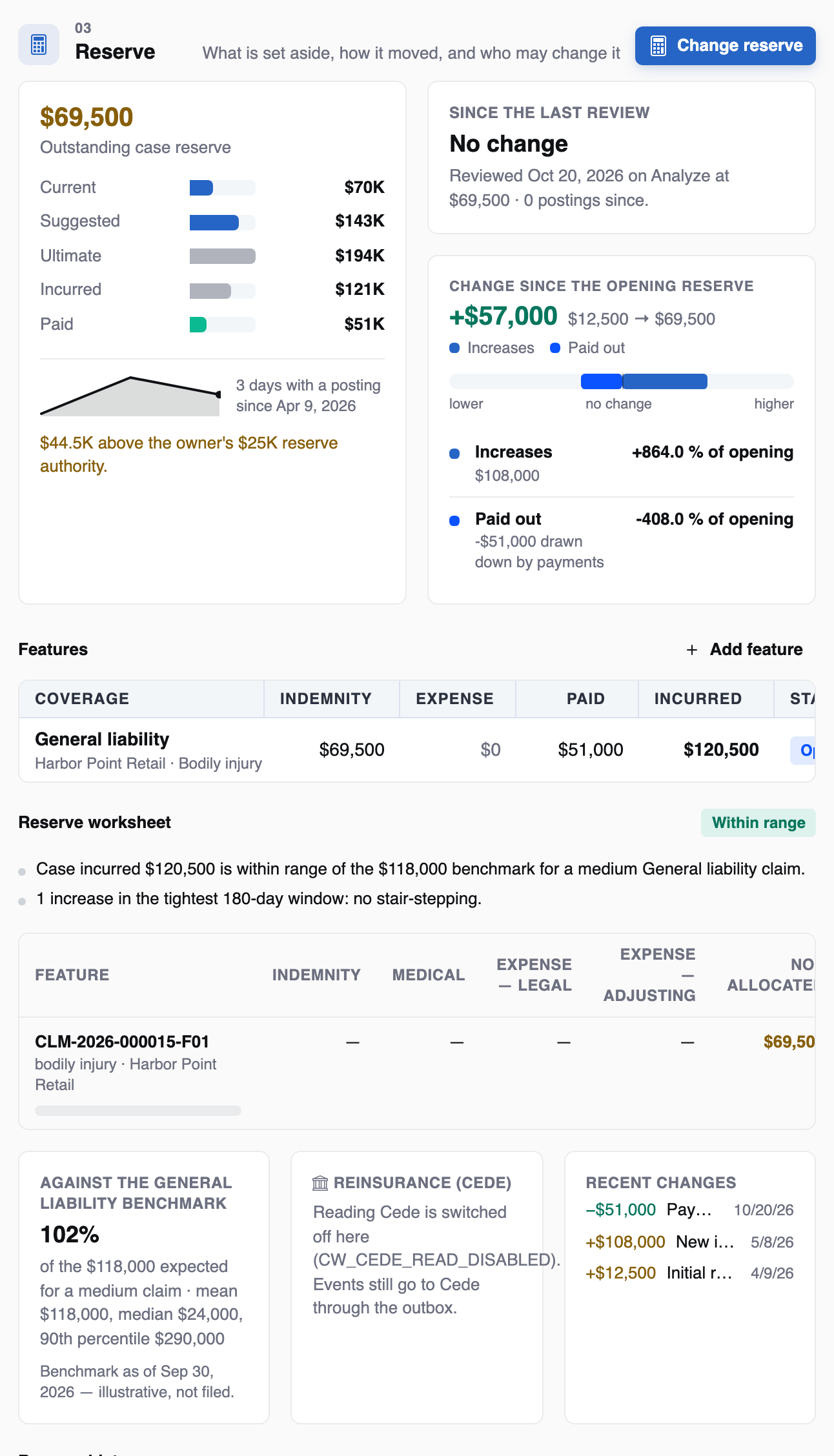
- The worksheet holds each feature's reserve by component, every change with a required reason, what is paid, and what InsightCede says is recoverable.
- Stair-stepping is a rule: three or more increases within 180 days on one claim. It is flagged on the worksheet and the reserving agent says how close a claim is to it.
- The reserving agent states its basis before its number, in a fixed order: the settled amount; the settlement evaluation; the median of at least three closed claims of the same line and type; the line's illustrative benchmark. With none of these, it says “no basis” and gives no number.
- Adequacy compares case incurred with the line's benchmark — illustrative, dated and marked as not actuarial advice wherever it appears.
- Authority applies to every change; above the limit, the supervisor agent prepares the approval with the reserve history and precedent.
What the model does not do
The model never sets a reserve. The reserving agent's figures come from the methods above; the model explains them, judges adequacy in words and challenges a stair-step. A model sentence with a number that is not one of the facts is thrown away.
See the workers' comp use case for stair-stepping caught on a live file, and grounded figures for why the model is kept away from the numbers.