A warehouse picker lifts a carton wrong and feels something go in the lower back. Workers' comp claims like this one are where most of a comp desk's money goes: not the catastrophic injuries, but the ordinary ones that run longer than they should, with treatment that drifts away from the injury and bills that nobody reads line by line.
This post follows one such claim through InsightCW — the team assignment, the indemnity facts, the medical review agent's findings, the reasonable-value range and the referral that fires when time off work passes ninety days. The worker, the employer and the amounts are illustrative, and so are the workers' comp schedules: InsightCW says so wherever it shows them, and they must be checked against the state's current schedule.
| Actors | Workers' comp adjuster (owner), nurse or medical reviewer, supervisor, the injured worker, the employer, treating providers |
|---|---|
| Trigger | An employer's first report of injury for a lifting injury, filed two days after the incident |
| Line | Workers' compensation: medical and indemnity features |
| Agents involved | Intake, coverage, reserving, medical review, correspondence, supervisor |
| Decisions and authority | Compensability (adjuster), reserves and payments inside the authority matrix, sending bills to medical review (a person — capped at L2), the long-TTD referral (supervisor) |
| Systems touched | InsightUW (policy at the loss date), InsightCede (reserve movements), InsightPulse (portfolio) |
| Outcome | Treatment that matches the injury is paid promptly; bills that do not are reviewed before payment; the reserve tracks the file instead of chasing it |
| What is measured | Days to first indemnity payment, medical paid per claim against the line's history, share of bills reviewed before payment, TTD duration, reserve changes per claim |
Where comp claims go wrong
Workers' comp is unusual among lines because the carrier pays medical bills directly and for as long as treatment is reasonable and related. That second condition — related — is where cost builds. An injury to the lumbar spine does not explain a shoulder MRI. Twelve weeks of passive therapy with no change in function does not explain twelve more. A provider billing the same procedure code twice on one date of service is either an error or a pattern.
of injury"] --> B["Assigned to
whoever is free"] B --> C["Bills paid as
they arrive"] C --> D["Reserve raised
when the file is noisy"] D --> E["Off work 90+ days
noticed at review"] E --> F["Bill review
after the money left"] style F fill:#fdecec,stroke:#e57373 style D fill:#fff4e2,stroke:#f4a03a
None of these steps is negligent on its own. The problem is order: money moves first and the question “does this bill match this injury?” is asked afterwards, if at all. InsightCW changes the order.
Workers Comp team"] B --> C["Indemnity facts:
AWW, TTD start"] C --> D["Bills arrive
as documents"] D --> E["Medical review agent:
treatment vs injury,
billing anomalies,
value range"] E --> F{"Person sends bills
to review or pays"} F --> G["Reserve follows
the evidence"] G --> H["90 days off work:
referral to supervisor"] style E fill:#efeafe,stroke:#7c6cf0 style F fill:#e8f8f4,stroke:#22c1a4,stroke-width:2px
Who talks to whom
Step by step
The policy at the injury date comes from InsightUW. The assignment rule ASSIGN_WC routes every workers' comp claim to the Workers Comp team; the severity rule SEV_INJURY_LIT marks it high because there is an injury. The acknowledgement and first-contact clocks start.
Notice complete except the wage statement. It prepares the information request to the employer from the governed template, listing exactly what is missing.
The line panel for workers' comp asks for its own facts: injury and body part, average weekly wage, TTD start date, weeks paid, the MMI date when it comes, and the PPD rating. They are stored on the claim and flattened into fields every rule and agent can read.
Indemnity and medical reserved separately by component. With no settlement evaluation yet, it reads closed comp claims of the same injury type on the line; with fewer than three it says so and leaves the figure to the adjuster.
Each document arriving re-runs the agents, debounced to once a minute per claim so a batch of uploads starts one run, not three.
It checks treatment against the recorded injury and body part, finds billing anomalies (a shoulder MRI on a lumbar claim; one procedure billed twice on the same date of service), and explains the reasonable-value range from the injury worksheet. It prepares “send these two bills to medical review”. It cannot send them itself: the action is capped at L2.
The adjuster accepts the prepared review for the two flagged bills and pays the third. The payment runs the payment controls first. The decision record keeps the review and the reason.
A second indemnity increase in two months. Three increases inside 180 days is stair-stepping by the worksheet's rule, and the agent says how close this file is to it — and what an adequate reserve would rest on instead of another step.
WC_LONG_TTD fires: the worker has been on temporary total disability for 90 days or more. It refers the file to the supervisor, which the supervisor agent prepares with the reserve history, the medical paid against the line's history and the open questions.
An independent medical exam, a return-to-work conversation with the employer and a reserve decision. The IME is tracked on the injury record; the diary carries the dates.
The reasonable-value range is a formula, not a model
Bodily-injury value is where AI in claims is most often oversold. InsightCW does not ask a model what an injury is worth. The injury worksheet is a transparent formula that anyone on the desk can re-run by hand:
# the injury worksheet's value range (cw_injury_service.value_range)
low  = (specials + medical x multiplier_low ) x liability_share x venue_factor
high = (specials + medical x multiplier_high) x liability_share x venue_factor
# defaults: multipliers 1.5 and 3, liability 100%, venue 1 — each one editable, each capped at the policy limit
The same helper serves the evaluation screen and the medical review agent, so the two can never disagree.
The medical review agent explains the range: which specials it counted, which it left out as unrelated, and why. The model writes the explanation; the formula writes the numbers. A model sentence carrying a figure the worksheet did not produce is thrown away.
Workers' comp schedules are illustrative
Fee schedules, waiting periods and benefit rates differ by state and change. The schedules InsightCW ships are illustrative and say so wherever they appear. A carrier replaces them with the states it writes before any of them drives a payment.
What the screens show
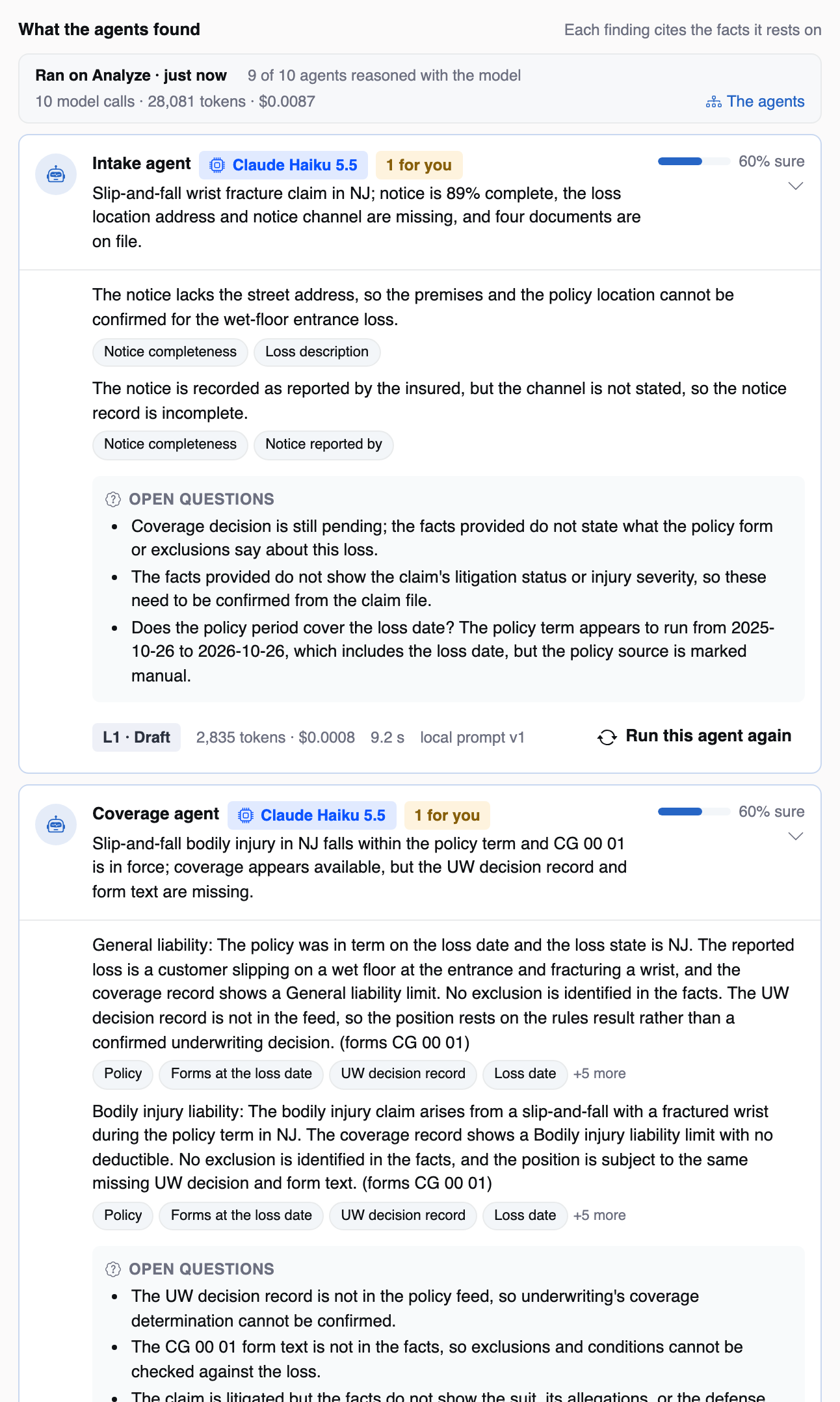
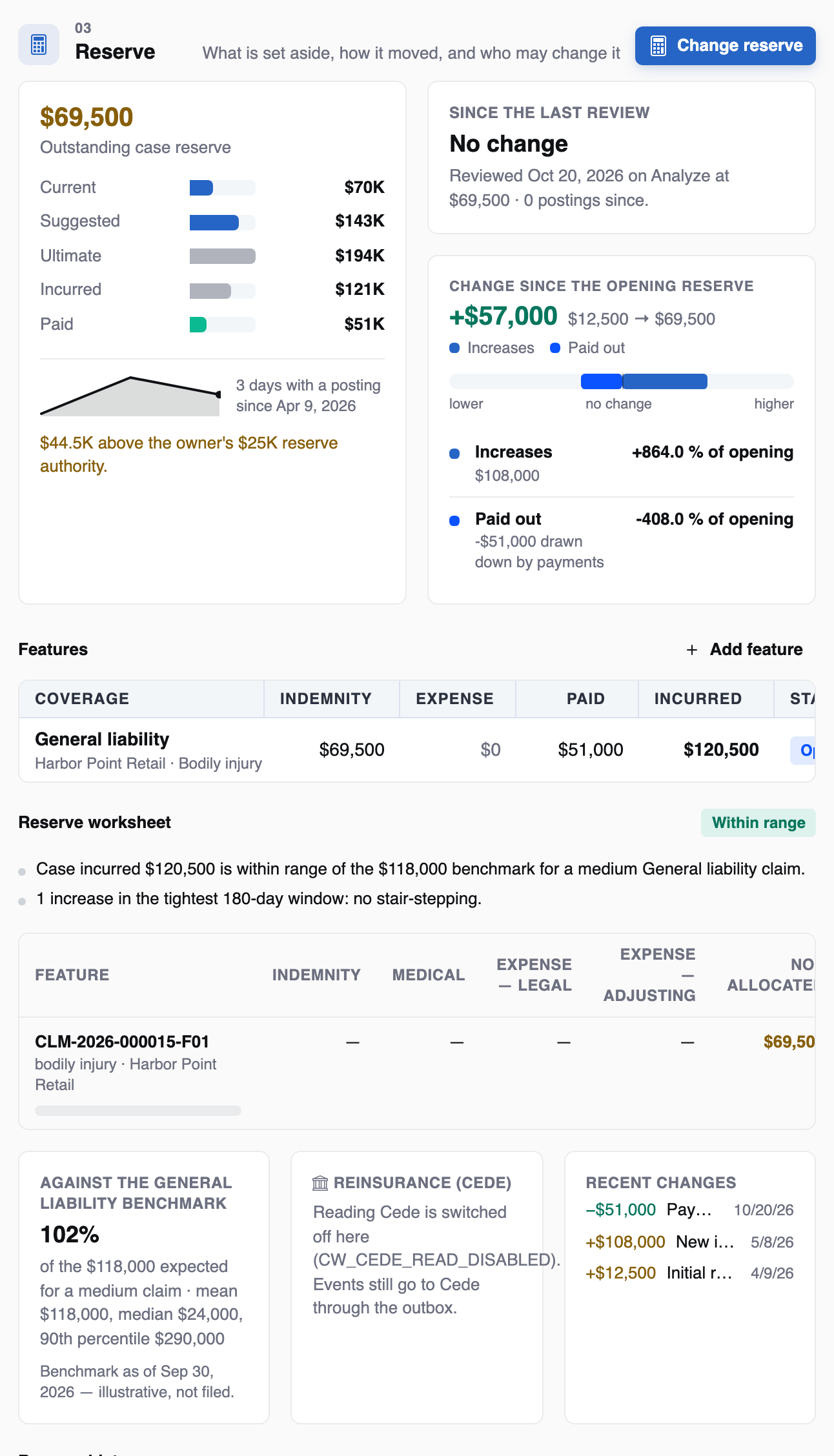
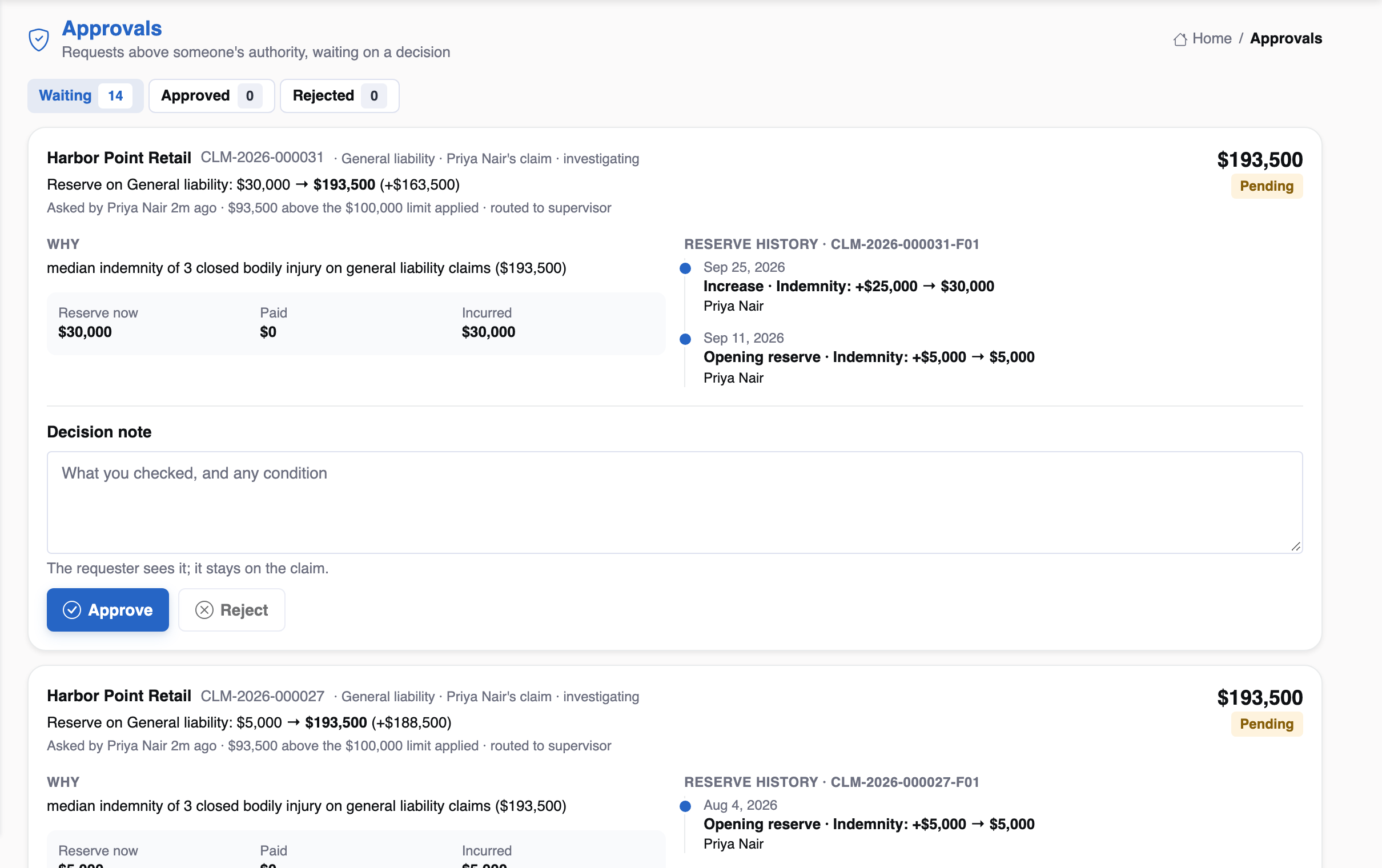
What the agents said, and what each answer rests on
| Agent | What it prepared | What it cites | Who decides |
|---|---|---|---|
| Intake | Wage statement missing; request to the employer drafted | Notice fields, documents on file | Adjuster sends |
| Reserving | Indemnity and medical by component; stair-stepping warning on the second increase | Closed comp claims of the injury type, reserve history, the worksheet rule (3 increases in 180 days) | Adjuster, within authority |
| Medical review | Two bills to review: treatment unrelated to the body part, a duplicate procedure line | The recorded injury and body part, the bill lines, the injury worksheet | A person, always |
| Correspondence | Status update due to the worker on the 30-day clock | The status-update clock | Adjuster sends |
| Supervisor | Brief for the 90-day referral: IME recommended, reserve history, medical paid to date | TTD weeks, reserve history, approvals, the referral rule | Supervisor |
Edge cases, and how authority stops them
| What happens | What InsightCW does |
|---|---|
| No body part recorded | The medical review agent cannot say a bill is unrelated to an injury it does not know, so it says what is missing and prepares nothing. |
| The provider is on a watch list | The provider-flag indicator raises the fraud score, and the fraud agent explains it beside the medical review — two findings, two sources, one file. |
| A manager sets medical review to L4 | No effect. Sending bills to medical review is capped at L2. |
| A bill is paid and later flagged | The flag still appears, with the payment named; a void goes through the ledger and tells InsightCede (claim.payment_voided). |
| The worker returns to work at day 60 | TTD stops accruing; the 90-day referral never fires; the reserving agent's next run reads the new facts. |
The decision record for this claim
On day 91, the Analyze run that followed the long-TTD referral read as follows. Notice how much of it is not about the referral: the record shows the whole state of the file at that moment, so the supervisor decides with everything in view.
| Section | Hit | Outcome |
|---|---|---|
| Coverage | Workers' compensation covered on the policy at the injury date | pass |
| Line | Workers' comp checks; wage statement on file; schedules marked illustrative | pass |
| Severity | High: an injury (SEV_INJURY_LIT) | warn |
| Line | WC_LONG_TTD: off work 90 days or more | refer |
| Fraud | Score 0; provider not on a watch list | pass |
| Authority | Indemnity reserve inside the adjuster's authority; no approval waiting | pass |
| Clocks | Status update to the worker due in 4 days | warn |
| Agent | Medical review: two bills prepared for review (source: agent) | warn |
| Agent | Reserving: second indemnity increase in 60 days; one more is stair-stepping | warn |
The verdict is refer, because the line rule refers and refer outranks warn. The supervisor agent's brief is built from the same run, so the brief and the record cannot disagree.
Ask the copilot
| Ask the copilot | Lookups it calls | What the answer covers |
|---|---|---|
| “How much medical have we paid, and on what?” | reserves_and_payments, documents | Medical paid by payee and bill, with the documents each payment rests on. |
| “Which bills are under review and why?” | decision_record, documents | The medical review agent's findings, each anomaly with its bill line. |
| “What does the reserve history look like?” | reserves_and_payments | Every change with its reason and date; whether the stair-stepping rule is close. |
| “What's overdue on this claim?” | diary_and_clocks | Overdue diary items with days late and each clock's hours left or late. |
Tuning it for your book
- Replace the schedules. The workers' comp schedules InsightCW ships are illustrative. Load the states you write before any of them drives a payment.
- The long-TTD threshold.
WC_LONG_TTDrefers at 90 days off work. Some desks refer at 60 for certain injury types; express that as a condition on the rule. - The value-range defaults. The injury worksheet's multipliers (1.5 and 3), liability share and venue factor are defaults per evaluation, editable on the worksheet. Agree the defaults with your bodily-injury leads; the agent explains whatever the worksheet holds.
- Assignment.
ASSIGN_WCroutes every comp claim to the Workers Comp team. Split it by state or injury type if your teams are organised that way.
On the desk
Bills that do not match the injury are flagged before you pay them, with the line and the reason. You decide what goes to review; the value range is a formula you can re-run.
For claims IT
The line panel's facts are stored as JSON on the claim and flattened into rule fields; the value range is cw_injury_service.value_range, shared by the screen and the agent.
For claims leadership
Comp cost is driven by duration and medical drift. Watch medical paid per claim against the line's own history, bills reviewed before payment, and reserve changes per claim.
Variations on this claim
A fatality
SEV_FATALITY makes the claim critical at once, assignment routes it to senior
adjusters, and the reserve almost certainly exceeds the adjuster's authority on day one — so
the supervisor agent prepares the approval with the authority gap and precedent. The medical review
agent has little to say; the correspondence agent's letters matter more, and a person writes
them.
The worker reaches maximum medical improvement
Recording the MMI date and a PPD rating changes what the reserving agent reads: indemnity moves from temporary to permanent partial, and the reserve's basis changes with it. The schedule that turns a rating into weeks is state-specific and, as shipped, illustrative.
Medicare entitlement
When the injured person may be a Medicare beneficiary, the injury record tracks the Section 111 obligations — the beneficiary query and the TPOC or ORM report. In this build those go through a stand-in transport: InsightCW prepares them and nothing leaves until a carrier connects its reporting agent.
A time-limited demand
On a liability claim with a bodily injury, a time-limited demand at or over the limit that the evaluation can reach is a policy-limits exposure: an urgent diary before the deadline and the supervisor told. Comp rarely produces these; general liability and auto produce them often.
Rolling it out on your desk
- Before go-live: replace the illustrative schedules with the states you write, and agree the injury worksheet's default multipliers with your bodily-injury leads.
- Week 1: require the injury and body part on every comp claim. The medical review agent cannot judge relatedness without them, and it will say so rather than guess.
- Weeks 2–6: medical review at L2, so flagged bills arrive as decisions. Compare what the agent flagged with what your nurse reviewers would have flagged; the Change and Reject answers are the evidence.
- Month 3: look at medical paid per claim and bills reviewed before payment against the months before. Both come from InsightCW's ledger.
What the person still decides
- Compensability. Whether the injury arose out of and in the course of employment is a legal judgement.
- Which bills go to review. The agent prepares the list; the adjuster or nurse sends it.
- The treatment plan conversation. An IME, a second opinion, a return-to-work offer — these are relationships, not rules.
- The reserve. The agent recommends with a basis; the person posts it, inside their authority.
What to measure
Medical paid per claim against the line's own history; the share of bills reviewed before payment rather than after; days to first indemnity payment; TTD duration; and reserve changes per claim, which falls when the first reserve rests on evidence. All are read from InsightCW's ledger and clocks; see measuring it.