A customer slips on a wet floor in a grocery store, breaks a wrist and, four months later, sues. A general liability claim that would have settled for its medical specials becomes a litigated file with a defense firm, a budget, a stream of electronic bills and a trial date eighteen months out. From here, most of what the claim costs is decided by how well it is managed, not by what happened on the floor.
This post follows one litigated GL claim through InsightCW: opening the suit, assigning panel counsel, the defense plan and its budget by UTBMS phase, reviewing a LEDES bill line by line against the billing guideline, the litigation agent's strategy and the diaries that keep the deadlines. The parties, the firm and the amounts are illustrative.
| Actors | Litigation specialist (owner), panel defense counsel, claims manager, the insured, plaintiff's counsel |
|---|---|
| Trigger | A suit served on the insured on an existing GL claim |
| Line | General liability: bodily injury feature, expense (defense) feature |
| Agents involved | Litigation, reserving, medical review, correspondence, supervisor |
| Decisions and authority | Counsel assignment, the defense plan and budget (claims manager), each bill's approval, settlement authority on the offer |
| Systems touched | InsightUW (claim.litigation_opened for the account), InsightCede (reserve movements; large-loss notice if the threshold is crossed), InsightPulse |
| Outcome | Defense spend inside the budget and the guideline, deadlines met, a reserve that reflects the plan, and a strategy decided early |
| What is measured | Defense spend against budget, bill reductions by reason, days to counsel assignment, deadlines missed (should be zero), litigated cycle time |
How litigated files drift
by habit"] B --> C["No budget, or a
budget nobody reads"] C --> D["Bills paid in
bulk each quarter"] D --> E["Expense reserve
raised in steps"] E --> F["Strategy decided
at mediation"] style D fill:#fdecec,stroke:#e57373 style E fill:#fff4e2,stroke:#f4a03a
Defense spend leaks in small amounts: an hourly rate above the guideline, block-billed entries, clerical work billed as legal time, a task code the guideline does not pay for, a sixteen-hour day. Each is minor on one invoice and material across a book of litigated claims. And because the plan was never priced, the expense reserve is raised every time a bill surprises someone.
agent reads the suit"] B --> C["Panel counsel by
venue state"] C --> D["Defense plan and
budget by UTBMS phase"] D --> E["Reserve the plan
implies"] E --> F["LEDES bills reviewed
line by line on
bill_review rules"] F --> G{"Specialist approves
the reviewed bill"} G --> H["Expense payment:
controls and
authority apply"] style F fill:#efeafe,stroke:#7c6cf0 style G fill:#e8f8f4,stroke:#22c1a4,stroke-width:2px
Who talks to whom
Step by step
Recording the suit on the claim opens the litigation record and emits claim.litigation_opened to InsightUW and InsightPulse. It is also one of the five events that start the agents on their own.
Deadlines (the answer date, mediation and trial dates as they are set), exposure from the reserve and the injury worksheet, and a recommended strategy — defend, or mediate early — with the reasons and the open questions. Capped at L2: the defense review is prepared for a person.
The counsel panel lists each firm with the states it serves, its rates by timekeeper class and its billing guideline. Assignment opens the defense plan and puts a high-priority diary on the claim for the firm's acknowledgement and initial report, due in 14 days.
The defense plan carries a budget by UTBMS phase. Its total implies an expense reserve, which the reserving agent compares with what is reserved now.
A LEDES 1998B e-bill arrives. Every line is reviewed against the guideline on bill_review rules, each cut with its reason: rate above the guideline for the timekeeper's class (cut to the rate), block billing (cut 20%), a fee line with no UTBMS task code (cut), a task or expense the guideline does not pay for (cut), clerical work billed as legal time (cut), more hours in a day than the guideline allows (time past the maximum cut).
The specialist sees the invoice, each cut and its reason, and approves the reviewed amount. Approval becomes an expense payment request on the claim, so payment controls and the authority matrix apply to legal spend like any other money.
Spend to date by phase against the budget, and the share of the bill the guideline cut. If a phase is running ahead of budget, it says so with the phase and the numbers from the ledger.
Mediation and trial dates become diaries on the owner's queue ahead of the date, ranked in Up next with the rest of the desk's work.
What the screens show
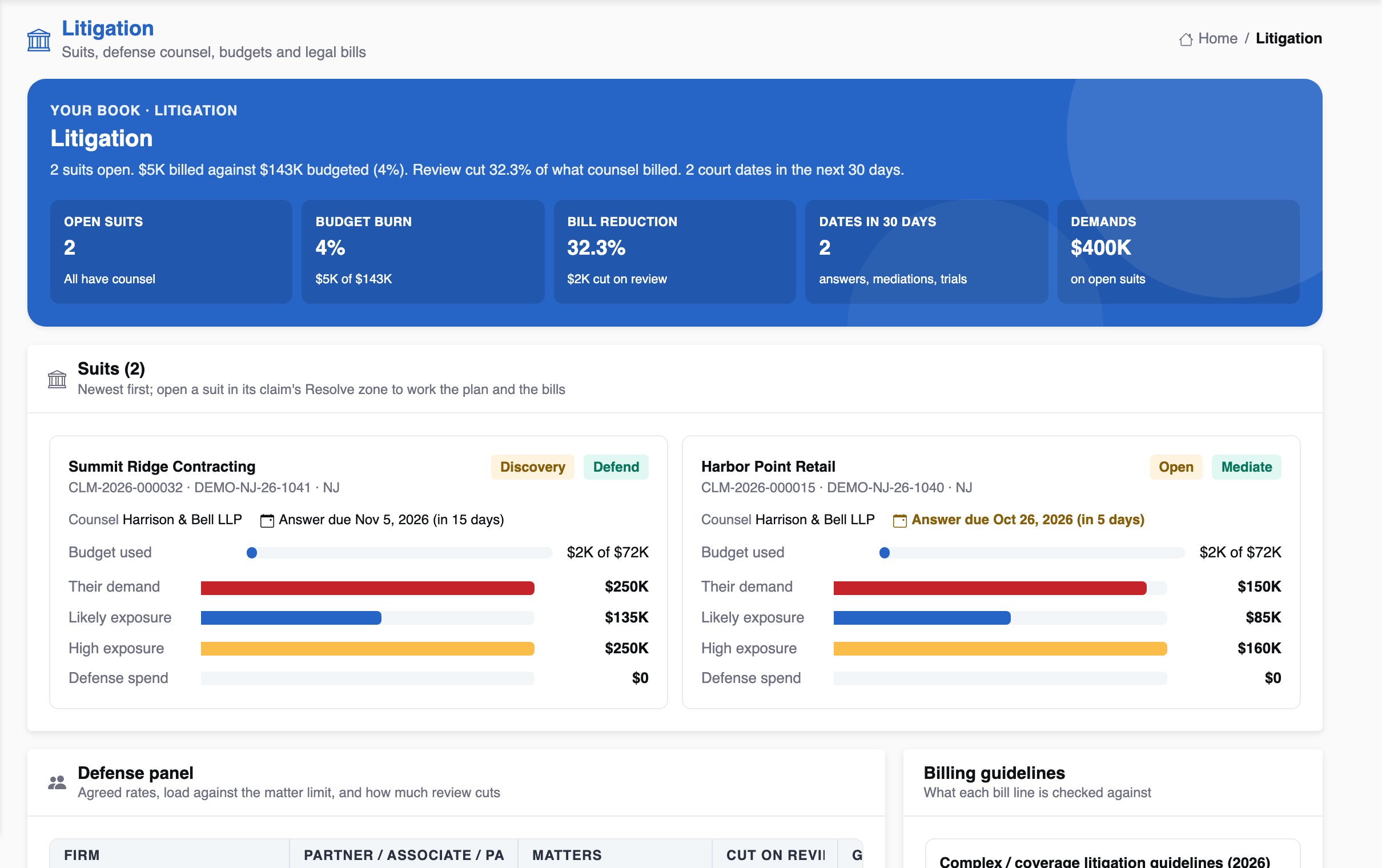
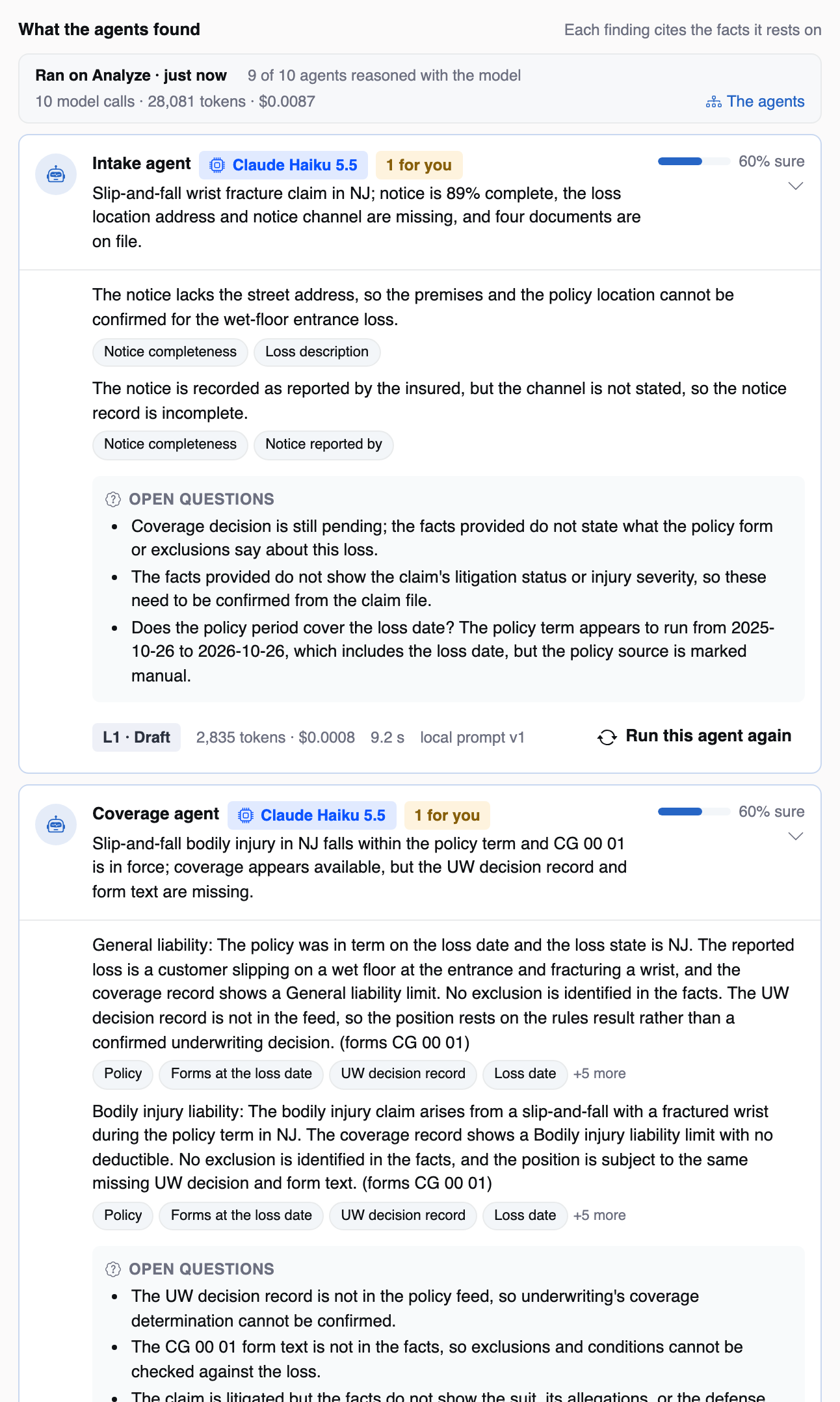
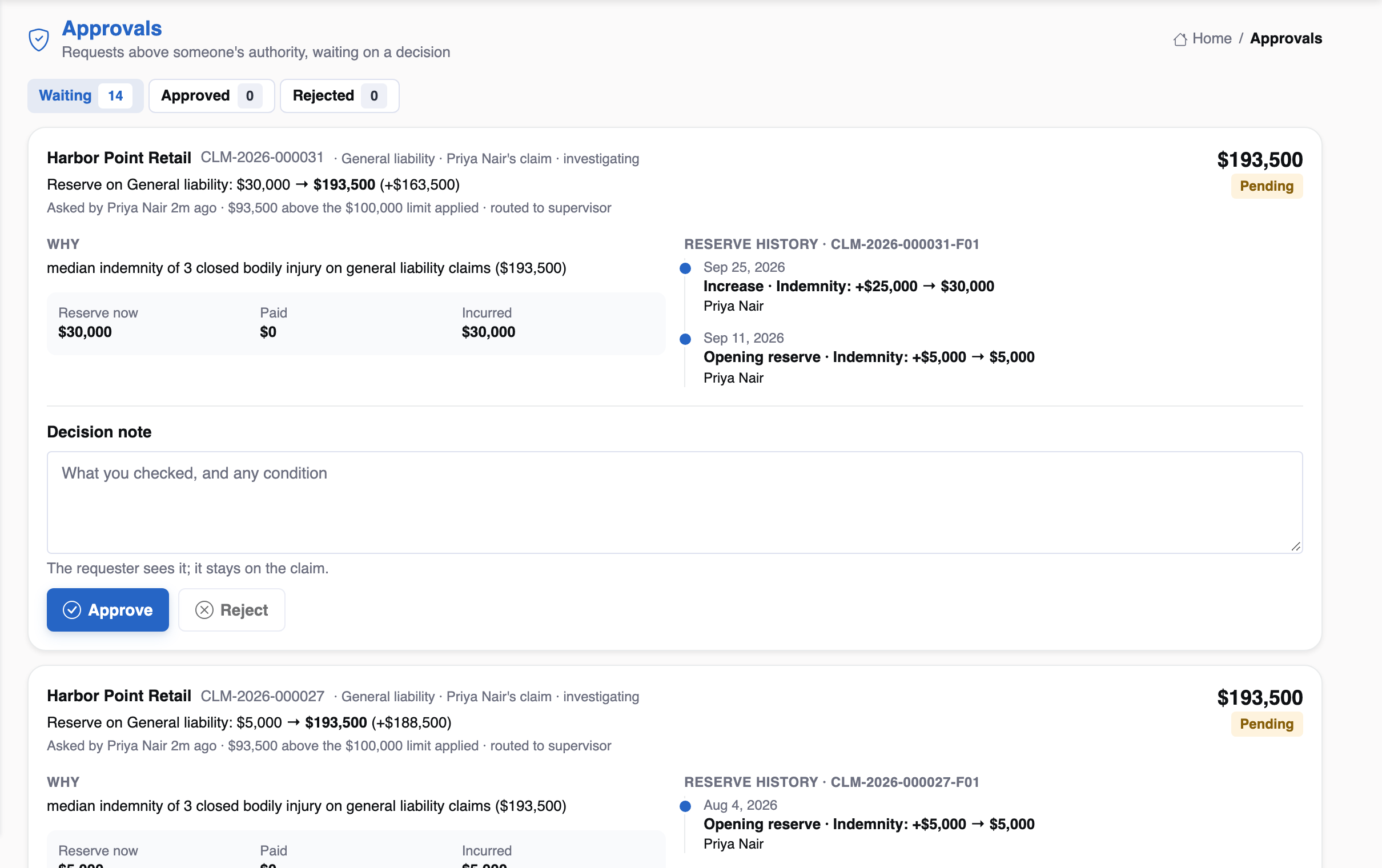
What the agents said, and what each answer rests on
| Agent | What it prepared | What it cites | Who decides |
|---|---|---|---|
| Litigation | Mediate early; answer due in 21 days; budget running ahead in discovery | The suit, the plan's phase budget, ledger spend, the guideline | Specialist, then manager |
| Reserving | Expense reserve below what the approved plan implies | Plan total, paid to date, reserve history | Within authority |
| Medical review | Specials reasonable for a wrist fracture; one unrelated bill | Injury and body part, bill lines, the injury worksheet | A person, always |
| Correspondence | Status update due to the insured | The 30-day status clock | Specialist sends |
| Supervisor | Brief for the budget approval | Authority gap, plan, precedent on the line | Claims manager |
Edge cases, and how authority stops them
| What happens | What InsightCW does |
|---|---|
| A firm bills above its panel rate | The rate rule cuts each line to the guideline rate and says so per line. |
| The guideline allows block billing for this firm | The block-billing rule checks the guideline's allowance and stays quiet. |
| Incurred crosses the GL large-loss threshold | The large-loss rule issues the management report and the reinsurers' notice once (see large loss). |
| A time-limited demand at or over the limit | The injury service treats it as a policy-limits exposure: an urgent diary before the deadline and the supervisor told. |
| The model recommends settling for a number | Any figure must be one of the facts; settlement authority applies to the offer itself, not just the payment. |
A reviewed bill, line by line
The first invoice, as the specialist sees it after review. Rates and hours are illustrative; the reasons are the rules' own messages.
| Line illustrative | Billed | Allowed | Rule and reason |
|---|---|---|---|
| Partner, review complaint, 2.0h | 900 | 800 | BILL_RATE_OVER: billed at 450 an hour; the guideline allows 400 |
| Associate, research, draft answer, call client, 6.0h | 1,500 | 1,200 | BILL_BLOCK: several tasks in one entry; cut 20% |
| Paralegal, organise file, 1.5h | 225 | 0 | BILL_CLERICAL: clerical work is overhead |
| Associate, draft discovery, 3.0h, no task code | 750 | 0 | BILL_NO_TASK_CODE: a fee line must carry a UTBMS task code |
| Associate, draft discovery, L310, 3.0h | 750 | 750 | — |
Nothing here needs a model. Bill review is the clearest case in claims for rules over AI: the guideline is a document the firm agreed to, and every cut must be explainable to the firm in the guideline's own terms.
Ask the copilot
| Ask the copilot | Lookups it calls | What the answer covers |
|---|---|---|
| “How is defense spend tracking against budget?” | litigation_recoveries_siu, reserves_and_payments | Spend to date by phase against the approved budget, and the share the guideline cut. |
| “What are the next deadlines?” | litigation_recoveries_siu, diary_and_clocks | Answer, mediation and trial dates with their diaries. |
| “What's our exposure?” | reserves_and_payments, decision_record, similar_closed_claims | The reserve, the evaluation range if one exists, and how similar suits closed. |
Tuning it for your book
- The guidelines. Load each panel firm's billing guideline: rates by timekeeper class, whether block billing is allowed, the daily-hours maximum, disallowed task and expense codes.
- The cuts. Block billing is cut 20% and over-maximum days 10% by default; these are parameters on the rules.
- The litigation agent's level. Its review is capped at L2; start it there so the strategy arrives as a decision.
On the desk
The suit, the plan, the budget and every bill sit on one claim. Review is done before you look; you approve the reviewed amount.
For claims IT
LEDES 1998B is parsed into lines and reviewed on bill_review rules; an approved bill becomes an expense payment request, so payment controls and authority apply.
For claims leadership
Defense spend is controllable. Watch spend against budget, reductions by reason and litigated cycle time.
Variations on this claim
A policy-limits demand arrives
A time-limited demand at or over the limit that the evaluation can reach is treated as a policy-limits exposure: an urgent diary before the deadline and the supervisor told. Missing that deadline is the single most expensive mistake in liability claims, and it is a date, so it is a diary.
The suit names a contractor too
If another party shares the liability, the recovery rules can raise a contribution or subrogation opportunity alongside the defense. Defending and recovering are separate pieces of work on the same file, each with its own owner if the desk wants.
The firm changes mid-case
A new firm gets its own plan and budget; spend to date stays with the phases it was billed against. The litigation agent reads both, so the strategy recommendation is not reset by the change.
Rolling it out on your desk
- Guidelines and panel: load each firm with its rates by timekeeper class, states served and billing guideline. Bill review only cuts what a guideline says.
- LEDES first: ask panel firms for LEDES 1998B. A PDF invoice can still be reviewed by a person, but the line-by-line rules need lines.
- Plan before spend: require a plan with a phase budget within the first weeks; the reserve the plan implies is the expense reserve's basis.
- Measure: spend against budget, reductions by reason, days to counsel assignment, and deadlines missed.
Questions we get asked
Does a model review the legal bills?
No. Bill review is rules against the firm's guideline, line by line, each cut with the guideline's reason. The litigation agent reads the result to compare spend with the budget.
What if a firm cannot send LEDES?
A person can still review and approve the invoice; the line-by-line rules need LEDES lines to work on.
Does an approved bill skip payment controls?
No. It becomes an expense payment request on the claim, so sanctions, duplicate and 1099 controls and the authority matrix apply.
Which model do the agents use, and what if it is unavailable?
By default the agent steps use Claude Haiku 5.5 through the platform's model client (on Bedrock where a region is configured), with a daily budget per agent; over budget, the fast model answers. If no model is configured, or a call fails, or the answer does not parse, the agents' rule-based findings stand and the step says the model did not run. Nothing in the claim waits on a model.
What the person still decides
- Counsel and strategy. The agent recommends; the specialist and manager decide.
- Each bill's approval, after the rules have done the line-by-line work.
- Every offer, inside settlement authority, before it is said out loud.