A late-model SUV is reported stolen from a mall car park. The policy is twenty-two days old. On day four a letter of representation arrives from the claimant's attorney. None of that proves anything. Cars are stolen from car parks, people buy insurance when they buy cars, and some people call a lawyer first. But together the facts deserve a second look — and a second look is exactly what a busy auto desk tends not to give.
Fraud is where AI in claims is most likely to do harm. A model that sees a suspicious claim behind every late report treats honest customers as suspects. This post follows one claim through InsightCW's SIU path and shows the balance it strikes: indicators raised by readable rules, a fraud agent that weighs the innocent explanations, a referral that only a person can file, and an SIU case on its own clock. The claim and people are illustrative.
| Actors | Auto adjuster (owner), SIU investigator, SIU manager, the claimant and their attorney |
|---|---|
| Trigger | Indicators on a new claim push the fraud score across the SIU threshold |
| Line | Auto (theft); the same path serves every line |
| Agents involved | Fraud, intake, coverage, supervisor |
| Decisions and authority | The SIU referral (a person files it — the action is capped at L2 whatever the dial says), case acceptance (SIU), the outcome and any fraud-bureau report (SIU) |
| Systems touched | InsightUW and InsightPulse (claim.siu_referred) |
| Outcome | A referral that is explainable indicator by indicator, an investigation with a plan and dates, and an outcome recorded on the claim |
| What is measured | Referral acceptance rate, investigation cycle time, outcomes by indicator, honest claims delayed by referral (should be low) |
The two ways fraud handling fails
It fails by missing things: indicators spread across a notice, a policy record and a letter that arrives later, never seen together. And it fails by over-reacting: a score with no explanation, a referral nobody can justify, an honest customer kept waiting. Both are expensive, the second in a way that does not show on the loss ratio.
across documents"] --> B{"Adjuster notices
the pattern?"} B -->|"busy week"| C["Paid without
a second look"] B -->|"sometimes"| D["Referral with
no explanation"] D --> E["SIU backlog;
honest claim delayed"] style C fill:#fdecec,stroke:#e57373 style E fill:#fff4e2,stroke:#f4a03a
facts change"] --> B["Fraud rules raise
indicators, each with
its rule and facts"] B --> C["Score rescored
and kept"] C --> D["Fraud agent weighs
each indicator and
its innocent reading"] D --> E{"Adjuster files
or declines the
prepared referral"} E --> F["SIU case: acceptance
on a clock, plan,
findings, outcome"] style D fill:#efeafe,stroke:#7c6cf0 style E fill:#e8f8f4,stroke:#22c1a4,stroke-width:2px
Who talks to whom
The indicators, and why they are rules
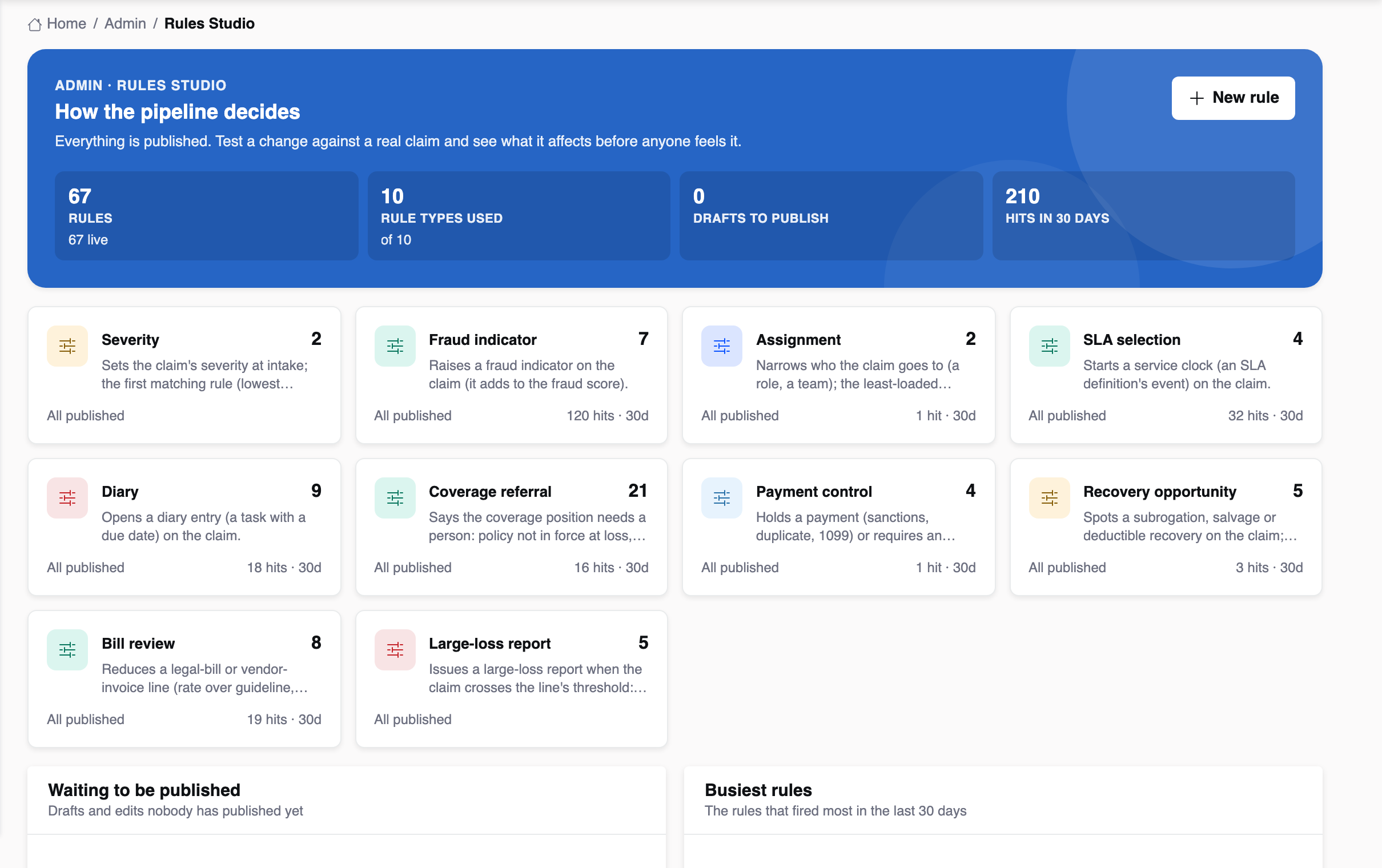
Every indicator in InsightCW is a published rule in the Rules Studio, so an SIU manager can read exactly what raises it and switch it off if it stops earning its place. The ones that matter for this claim:
| Rule | What it checks | Weight |
|---|---|---|
FRD_RECENT_POLICY | Loss within 30 days of inception | medium |
FRD_THEFT_TOTAL | Vehicle or property stolen and never recovered | high |
FRD_EARLY_ATTORNEY | Claimant represented within a week of the loss | low |
FRD_PRIOR_CLAIMS | Two or more similar claims by the insured in three years | medium |
FRD_NEAR_EXPIRY | Loss within 30 days of the policy ending | medium |
FRD_AFTER_POLICY_END | Reported after the policy ended | medium |
The score is simple arithmetic over the live indicators — low counts 5, medium 15, high 30, times each indicator's weight, capped at 100 — and every rescore is kept, so the trend is visible and explainable. When the score crosses 50, the owner is told and a referral is recommended. Here: recent policy (15), theft total loss (30) and an early attorney (5) make 50.
Step by step
Recent policy and theft total loss fire. Each indicator records which rule raised it and on which facts. Score 45: below the threshold, visible on the decision record.
The letter is a document; it re-runs the agents. The early-attorney rule fires. Score 50: the threshold is crossed and the owner is told.
For each indicator it states the suspicious reading and the innocent one — a new policy because the car is new; an attorney because the claimant has one for other matters — and recommends refer, monitor or no action. It prepares the referral. It cannot file it: SIU referral is capped at L2.
The adjuster reads the weighing and files the referral, or declines it with a reason. Either way the decision record keeps the answer, which is the evidence the autonomy dial and the fraud rules' owners later read. Filing emits claim.siu_referred to InsightUW and InsightPulse.
The referral waits for SIU acceptance on an SLA clock, so it cannot sit unread.
An accepted referral starts with a default plan the investigator edits: search prior claims (including ISO ClaimSearch, worked by the investigator), a recorded statement from the claimant, and records that test the story — repair, phone, police.
Findings and the outcome are recorded on the case. Where a state fraud bureau or NICB report is due, InsightCW prepares it; in this build the transport is a stand-in and nothing leaves CW until a carrier connects it. The illustrative state table sets the days within which a report is expected.
Why the fraud agent can never file
A referral changes how a customer is treated. Some actions should always have a person's name on them, whatever the evidence says about an agent's accuracy. Filing an SIU referral is one of six actions InsightCW caps at “ask first” regardless of the dial. The agent's job is to make the person's decision fast and well-informed — including the reasons not to refer.
What the screens show
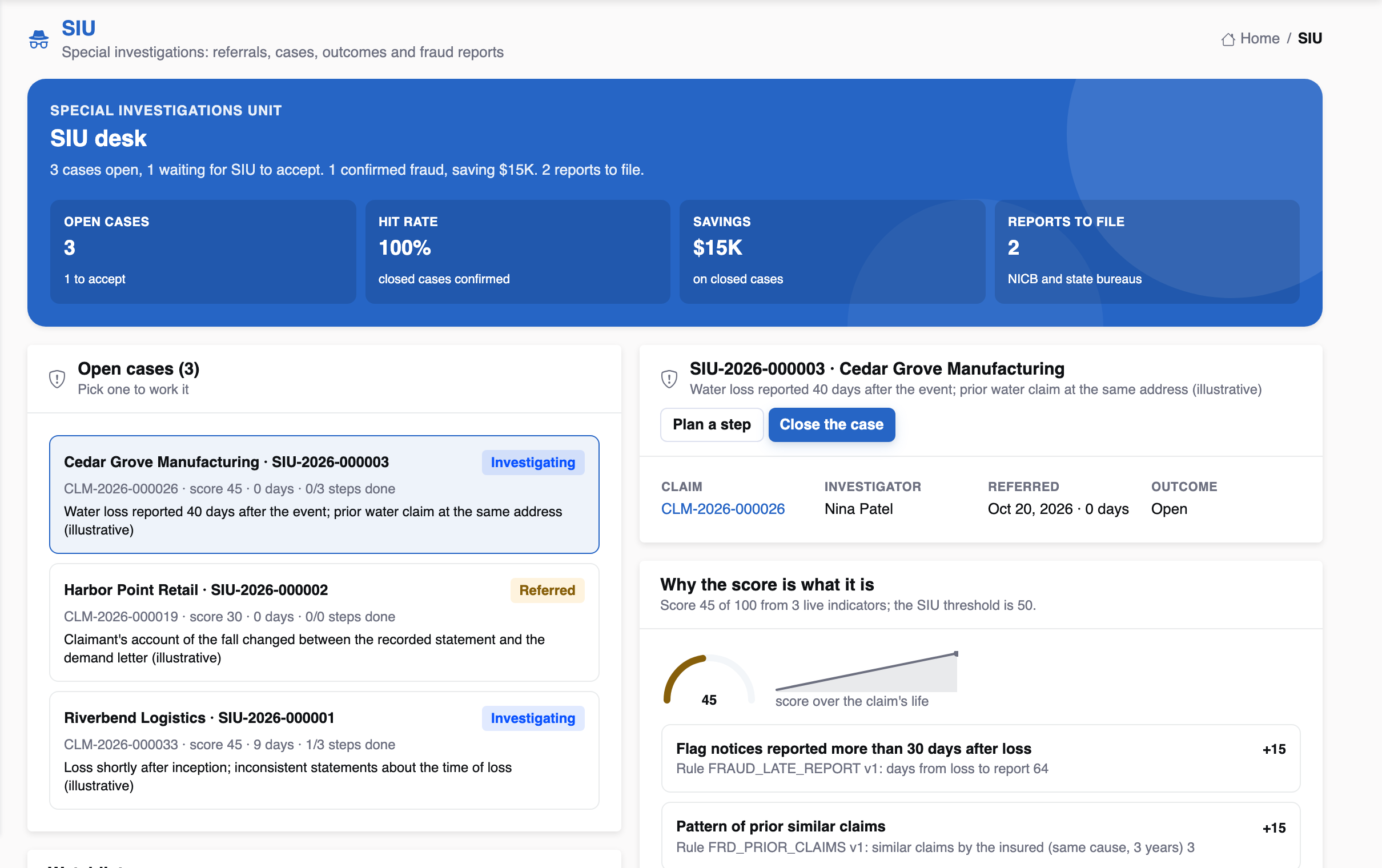
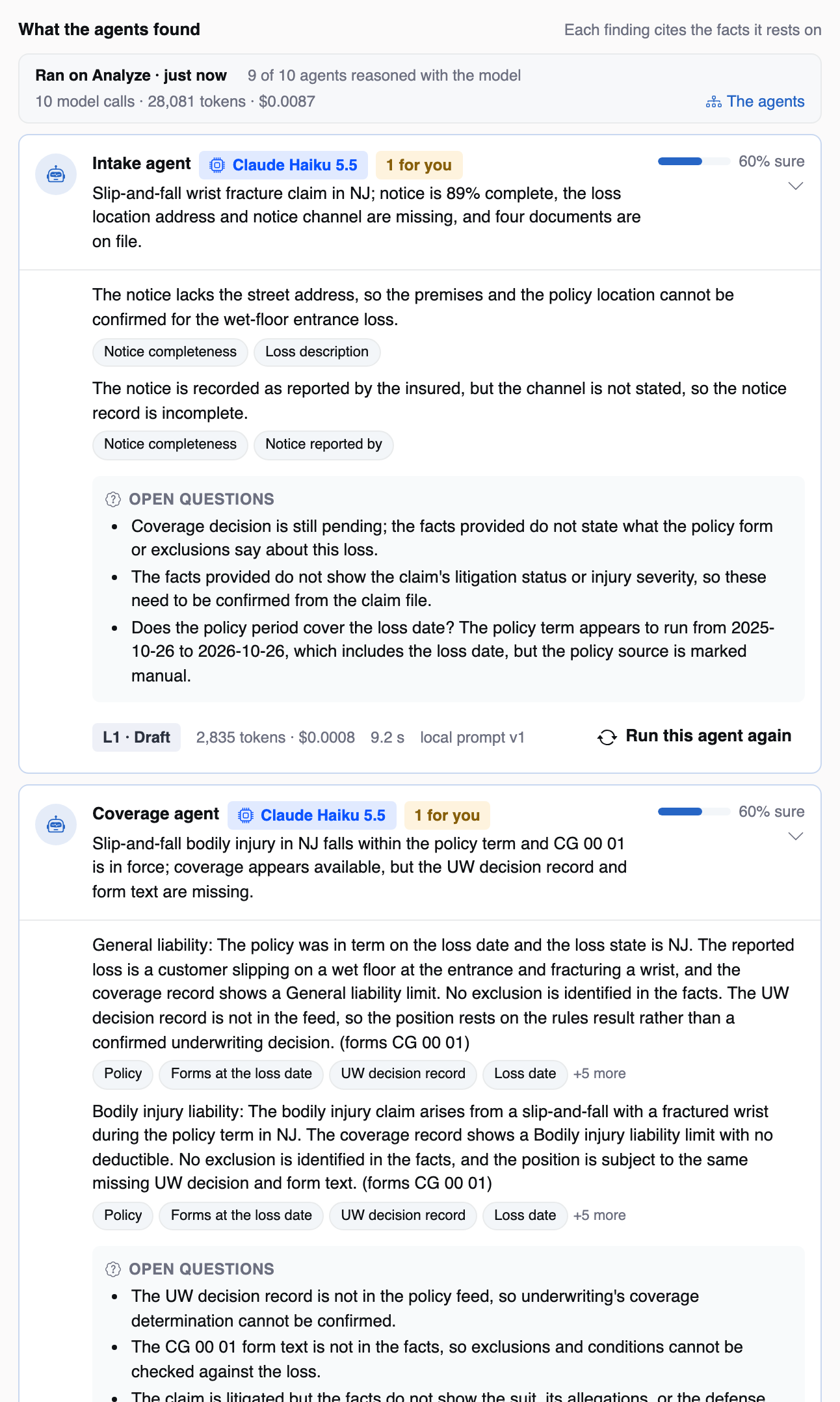
What the agents said, and what each answer rests on
| Agent | What it prepared | What it cites | Who decides |
|---|---|---|---|
| Fraud | Refer: three indicators, the strongest the unrecovered theft; innocent readings stated for each | Indicators and the rules that raised them, the score history, policy dates, the attorney letter | A person, always |
| Intake | Notice complete; police report attached | Notice fields, documents | Adjuster |
| Coverage | Comprehensive covered on the policy at the loss date; the adjuster may reserve rights while SIU investigates | Policy at the loss date from UW | Adjuster |
| Supervisor | Brief if a payment is requested during the investigation | The open referral, the authority line | Supervisor |
Edge cases, and how authority stops them
| What happens | What InsightCW does |
|---|---|
| The rules didn't prepare a referral but the model thinks one is warranted | The model may prepare one; it is still capped at L2 and a person files it. |
| The rules prepared a referral and the model disagrees | The rules' referral stands; the model's weighing sits beside the indicators for the person to read. |
| An indicator rule produces too many false alarms | Its owner sees its hits and the declined referrals in the Studio and can change or switch it off; drafts are tested against real claims first. |
| The car is recovered | The theft indicator stops being live, the score is recomputed and kept, and the file says why it fell. |
The decision record for this claim
On day 4, after the attorney letter, the run read:
| Section | Hit | Outcome |
|---|---|---|
| Coverage | Comprehensive covered on the policy at the loss date | pass |
| Fraud | Score 50 (from 45): FRD_RECENT_POLICY, FRD_THEFT_TOTAL, FRD_EARLY_ATTORNEY | refer |
| Authority | No reserve above authority; no approval waiting | pass |
| Clocks | Acknowledgement met; coverage decision due | pass |
| Agent | Fraud weighing: refer, innocent readings stated; referral prepared (source: agent) | refer |
An SIU-level score makes the verdict refer. The record also keeps every rescore, so the move from 45 to 50, and the letter that caused it, are visible.
Ask the copilot
| Ask the copilot | Lookups it calls | What the answer covers |
|---|---|---|
| “Why is the fraud score 50?” | decision_record | Each live indicator, the rule that raised it and the facts it read; the score arithmetic. |
| “What has SIU done so far?” | litigation_recoveries_siu, diary_and_clocks | The case status, the plan's activities and their dates. |
| “Has the insured had similar claims?” | similar_closed_claims, claim_overview | Book statistics; named claims only from the asker's own book. |
Tuning it for your book
- The threshold. The SIU threshold is 50. Your SIU capacity should set it: a threshold that produces more referrals than SIU can accept just moves the backlog.
- Each indicator's weight. Low, medium and high count 5, 15 and 30. Review indicators quarterly against outcomes; the Studio shows each rule's hits.
- State bureau timelines. The days within which a state expects a report are an illustrative table; replace it with your compliance team's.
On the desk
The indicators are explained, the innocent readings are on the page and the referral is prepared. You decide, and your answer teaches the system.
For claims IT
Indicators are published fraud rules; every rescore is kept in cw_fraud_score; filing emits claim.siu_referred.
For claims leadership
Measure acceptance rate and outcomes by indicator, not referral volume. A good programme refers fewer claims and finds more.
Variations on this claim
A pattern of prior claims
FRD_PRIOR_CLAIMS fires when the insured has two or more similar claims in three
years. The fraud agent's innocent reading matters most here: some insureds are simply unlucky,
and some businesses have more exposure than others. The copilot can show book statistics on
similar claims; it names individual claims only from the asker's own book.
A loss days before the policy ends
FRD_NEAR_EXPIRY raises a medium indicator for a loss within 30 days of the policy
ending. On its own it rarely justifies a referral; with other indicators it may. The score
arithmetic makes that explicit rather than leaving it to instinct.
The referral is declined
The adjuster declines the prepared referral with a reason. The decline is feedback: if an indicator rule produces mostly declined referrals, its owner sees it and can change it. That loop is how a fraud programme gets quieter and sharper over time.
Rolling it out on your desk
- SIU owns the catalogue: the SIU manager reviews each fraud rule, its weight and the threshold before go-live.
- Fraud agent at L2: referrals arrive as decisions with the weighing. It can never go higher for this action.
- Acceptance clock: agree the SLA for SIU acceptance so referrals cannot sit.
- Quarterly review: outcomes by indicator; retire the ones that do not earn their place.
Questions we get asked
Is the fraud score a model's output?
No. It is arithmetic over the live indicators raised by published rules: low 5, medium 15, high 30, times each indicator's weight, capped at 100. The model weighs the indicators in words; it does not set the score.
Can a manager let the fraud agent file referrals on its own?
No. Filing an SIU referral is capped at L2 whatever the dial says.
Does InsightCW send reports to NICB or state bureaus?
It prepares them. In this build the transport is a stand-in and nothing leaves CW until a carrier connects it.
Can an auditor replay what happened?
Yes. Every Analyze, stage action and payment hold writes a run to the decision record, with the hits in order, the rule and facts behind each, and the verdict. Every agent step records its model, tokens, cost and confidence, and a Lense trace when tracing is configured.
What the person still decides
- Whether to refer. Always a person.
- How the customer is treated meanwhile — a reservation of rights, a payment, a conversation.
- The investigation and its outcome, and any bureau report.