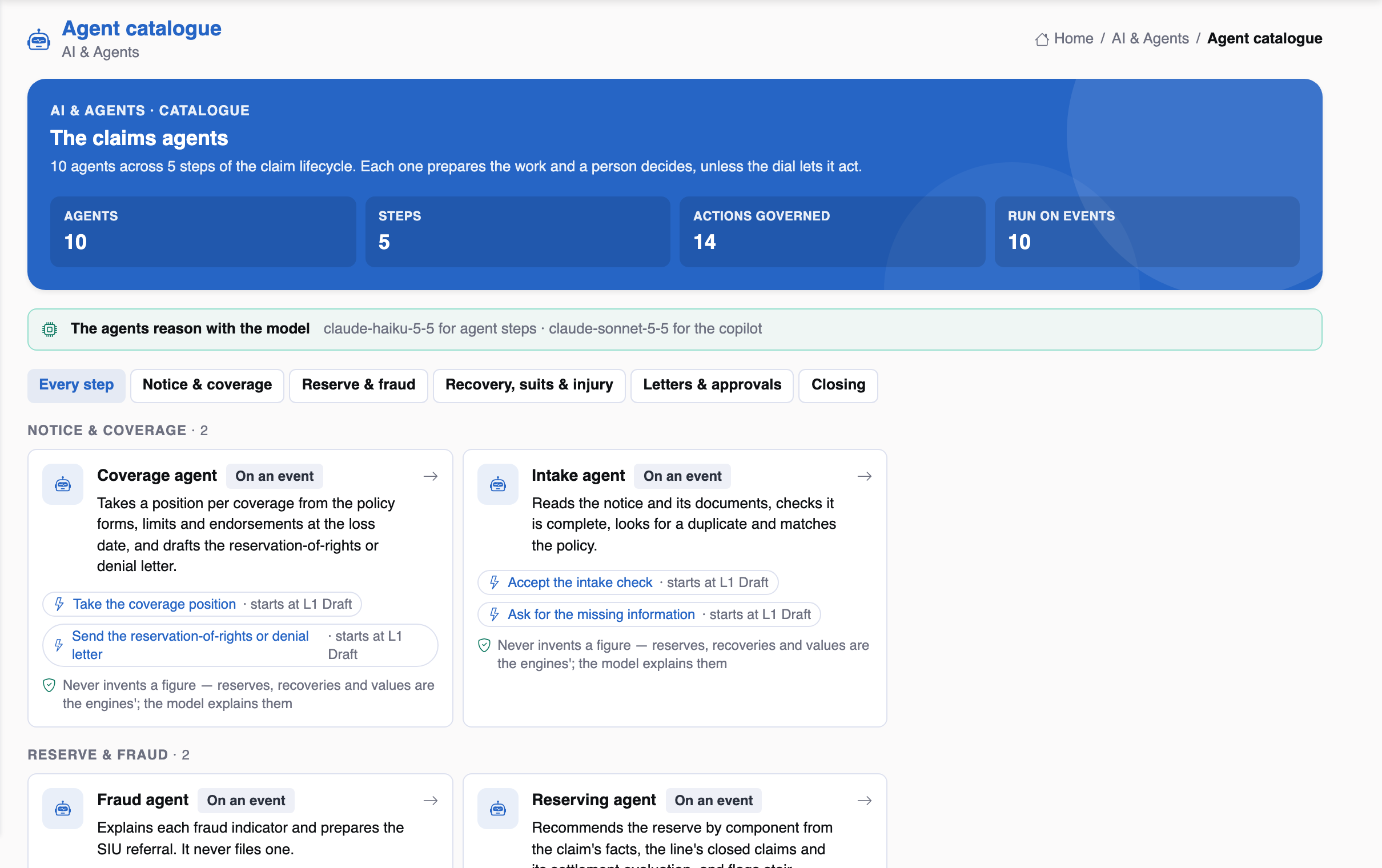
InsightCW has ten claims agents. Each one owns a piece of the work a good adjuster does on every file — read the notice, check coverage, set the reserve, look for fraud and recoveries, watch the suit, read the bills, write the letters, brief the supervisor, close cleanly — and each one prepares that work for a person rather than doing it behind their back.
Gather, reason, propose, govern
the facts, from the file,
the ledger and the rules,
each with its source"] --> R["Reason
the model reads the facts
with the file and answers
in a fixed shape"] R --> P["Propose
a prepared decision:
recommendation, reasons,
facts, draft"] P --> V["Govern
the autonomy dial and
hard caps decide whether
a person must answer"] style R fill:#efeafe,stroke:#7c6cf0 style V fill:#e8f8f4,stroke:#22c1a4,stroke-width:2px
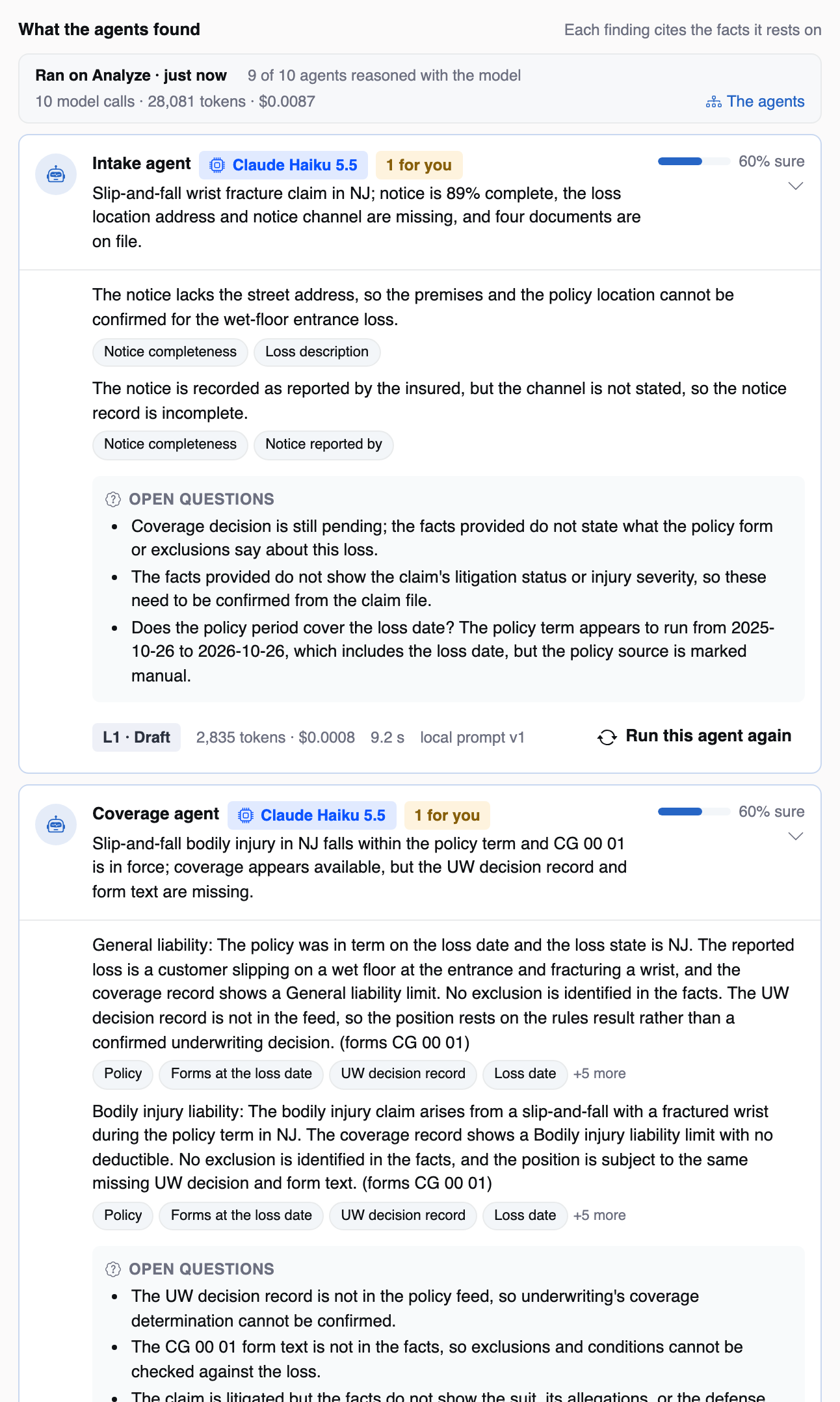
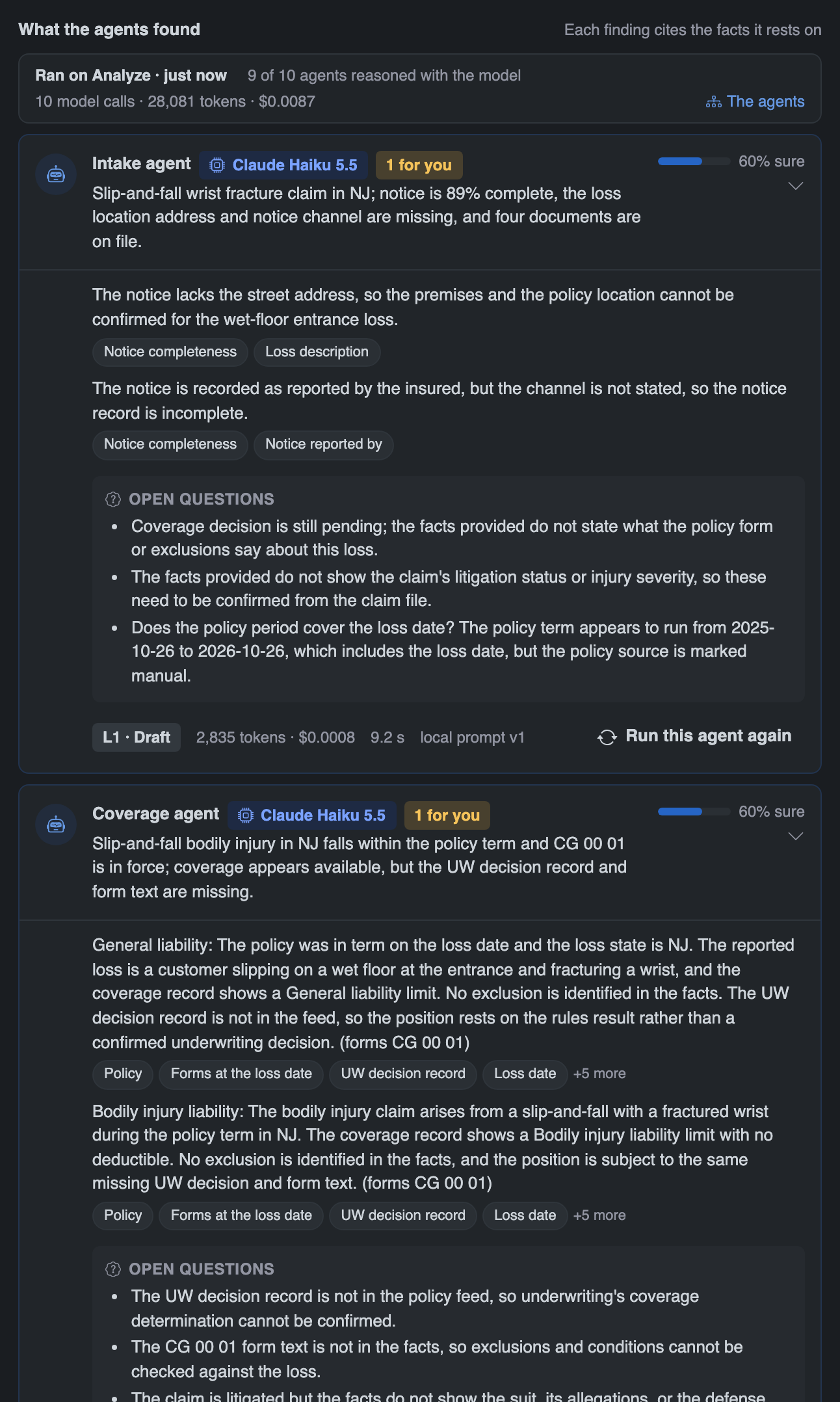
Every agent works the same way. Gathering is deterministic: the facts come from the claim, the ledger, the policy InsightUW returned and the rules, and every fact carries its source. Reasoning is the model's: it reads the facts with the file and writes the analysis, the findings, the open questions and a confidence. Proposing turns that into a prepared decision. Governing decides whether the agent may act, or must ask.
The ten, in the order they run
| Agent | What it does | Actions |
|---|---|---|
| Intake | Reads the notice and its documents, checks completeness, looks for a duplicate and matches the policy | intake check; information request |
| Coverage | Takes a position per coverage from the forms, limits and endorsements at the loss date; drafts the reservation-of-rights or denial letter | coverage position; coverage letter |
| Reserving | Recommends the reserve by component from the facts, closed claims and the settlement evaluation; flags stair-stepping | reserve change; payment request |
| Fraud | Explains each indicator, weighs innocent explanations and prepares the SIU referral | SIU referral (capped at L2) |
| Subrogation | Finds who may be liable, estimates the recovery and the limitation date | recovery opportunity (capped at L2) |
| Litigation | Assesses the suit: deadlines, exposure, defense spend against budget and guideline, strategy | defense review (capped at L2) |
| Medical review | Checks treatment against the injury, finds billing anomalies, explains the value range | medical review (capped at L2) |
| Correspondence | Drafts the letters the clocks call for and chases overdue diary entries | statutory letters; diary chase |
| Supervisor | Prepares each approval with the authority gap, reserve history and precedent | approvals (capped at L2) |
| Closure | Works the closing checklist and prepares the close with the letter drafted | close (capped at L2) |
Order matters: each agent reads what the ones before it wrote. The reserving agent reads the coverage position; the supervisor agent reads the reserving agent's figure; the closure agent reads everything.
The rules the model must follow
- Figures are the engines'. Reserves, recoveries, value ranges and authority gaps come from the ledger and the methods; any number the model writes must be one of the facts. See grounded figures.
- Coverage only moves towards caution. A denial needs a form number on the policy at the loss date; without one it becomes a reservation of rights.
- The supervisor's recommendation only tightens.
- The rules' SIU referral stands; the model may prepare one the rules did not, and a person files it.
- Letters keep their governed templates; the model writes the variable text.
- A finding with no cited fact is dropped, and a party the model names must be in the file.
When they run
On Analyze, and on their own when the file changes: a notice converted, a document arrived, a reserve changed, a payment requested, a suit recorded. See autorun. A dry run — “What would they do?” — runs everything and writes nothing.
Which model
Agent steps default to Claude Haiku 5.5 through the platform's model client, on when a model is configured, with a daily budget per agent, retries behind a circuit breaker, PII redacted before anything reaches the prompt, prompts versioned in InsightPrompts and a Lense trace per step. With no model, the rule-based findings stand and the step says so. In our own dry run on one demo claim, nine agents reasoned with the model in about 77 seconds for under one cent of model cost; your claims and settings will differ.