The question every claims executive asks about agents is not “how smart are they?” It is “what are they allowed to do without us?” InsightCW answers it with a dial per agent, per line, per action — and ships with the dial turned to “ask first” for everything.
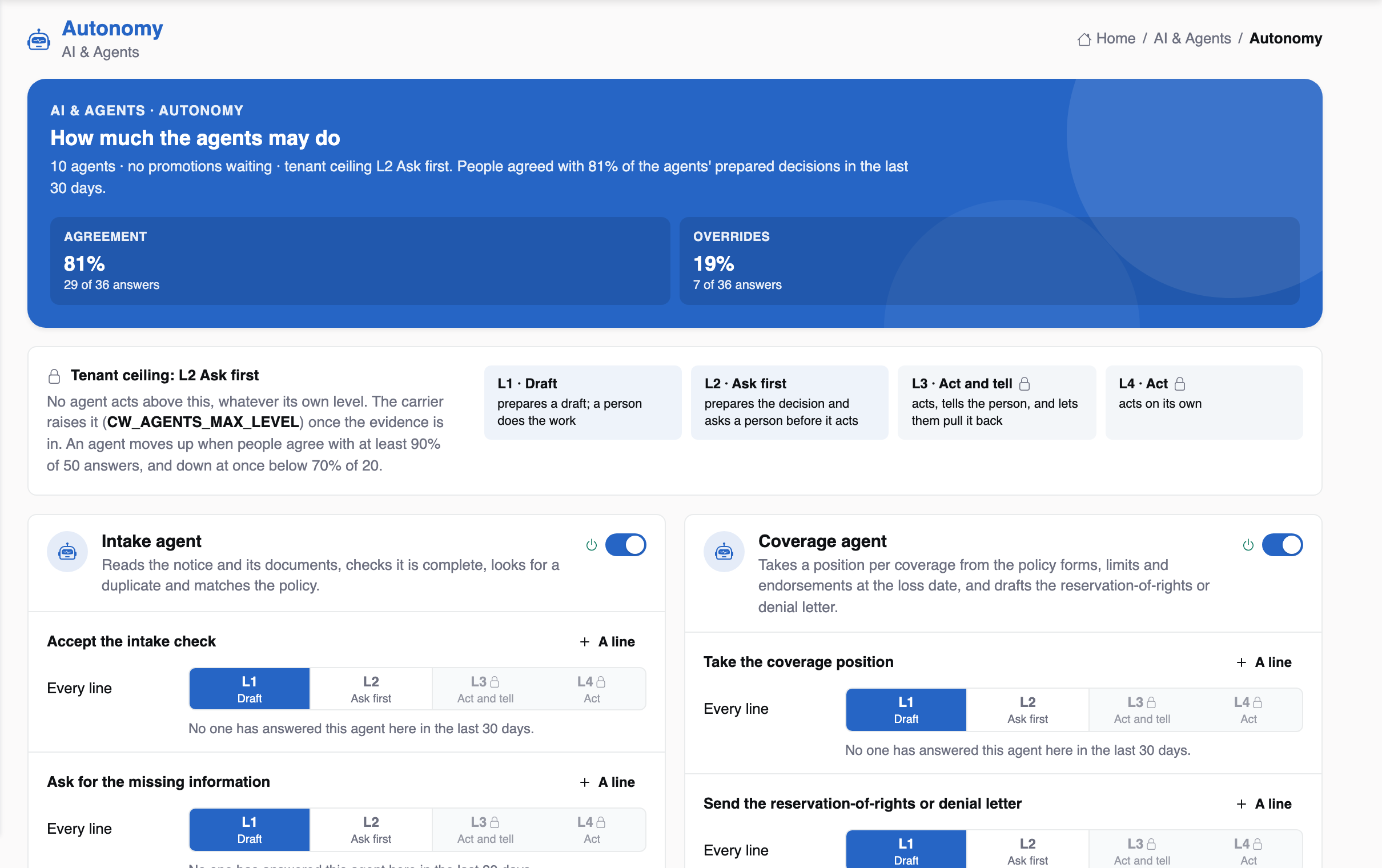
Four levels
| Level | Name | What it means |
|---|---|---|
| L1 | Draft only | The agent drafts; nothing is put in front of anyone as a decision |
| L2 | Ask first | The agent prepares the decision; a person answers it |
| L3 | Act and tell | The agent acts, tells the owner, and the action can be pulled back for a window |
| L4 | Act | The agent acts |
An action's effective level is the lowest of three: the level set for that agent, line and action; the action's hard cap; and the tenant ceiling. The ceiling ships at L2, so out of the box no claims agent acts on its own. The kill switch drops an agent to L1 at once.
Six actions a person always takes
Some actions should carry a person's name whatever the evidence says about an agent's accuracy. These are capped at L2 regardless of the dial: filing an SIU referral, deciding an approval, opening a subrogation opportunity, a defense review, a medical review, and closing a claim.
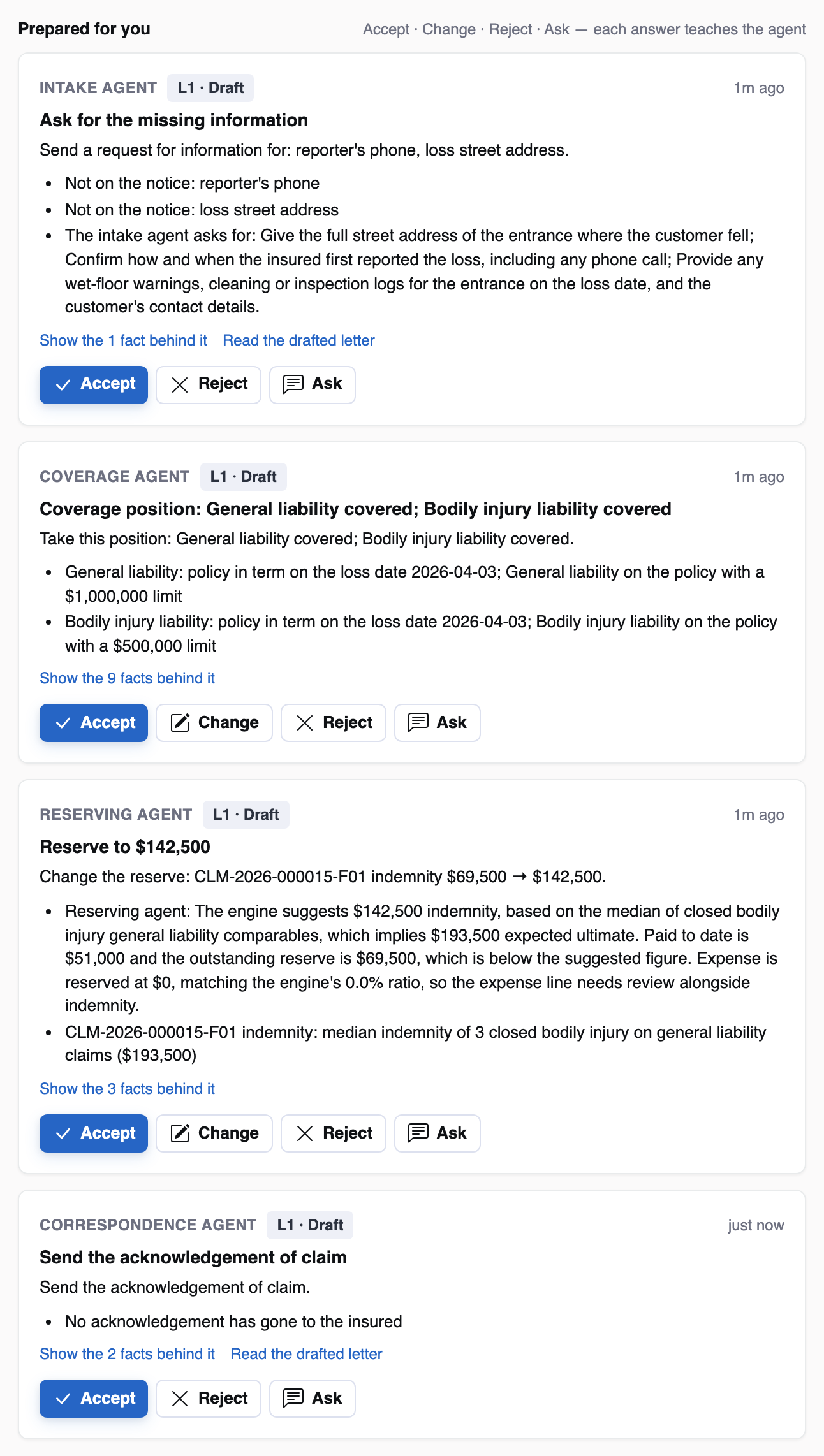
Prepared decisions: Accept, Change, Reject, Ask
recommendation, reasons,
facts, draft"] --> B{"Person answers"} B -->|"Accept"| C["Carried out as
the person"] B -->|"Change"| D["Carried out with
the person's edits"] B -->|"Reject"| E["Nothing happens"] B -->|"Ask"| F["Answered from
the facts"] C --> G["Feedback recorded"] D --> G E --> G style B fill:#e8f8f4,stroke:#22c1a4,stroke-width:2px
Accept, Change and Reject carry the decision out as the person and record feedback on the agent. Ask is answered from the facts and records nothing. Carrying a decision out goes through exactly the same code as a person doing it by hand, so an agent can never do something a person couldn't.
Evidence earns a notch; poor answers lose one
An hourly job rolls up 30 days of answers per agent, line and action. Agreement is accepted divided by accepted plus changed plus rejected. At 90% or more over at least 50 answers, it recommends a promotion, which a manager accepts or not. Below 70% over at least 20 answers, it demotes at once, audits the change and tells the claims managers.
Pull-back at L3
When a carrier raises the ceiling and an agent acts at L3, some actions open a pull-back window. A payment request can be voided; a letter is held and sent only when the window closes. The owner sees active windows on the claim and in their own list. If nobody pulls it back, the action stands.
Where most carriers should start
At the shipped ceiling. Run the agents at L2 for a quarter, read the agreement numbers by line, and raise the ceiling only for actions where the evidence is strong and pull-back exists. See the first ninety days.